
The inaugural session of the Intergovernmental Science-Policy Panel on Chemicals, Waste and Pollution (ISP-CWP) in Geneva marked a historic milestone in global environmental governance. Over five intensive days, Member States laid the groundwork for a new global body designed to bridge the science-policy gap on chemicals, waste, and pollution.
Day 1: Setting the Foundation
The session opened with high-level remarks, signaling both ambition and urgency.
A historic tone was set by Inger Andersen, Executive Director of United Nations Environment Programme (UNEP), who underscored the Panel as a critical step toward strengthening the global science-policy interface. As of 30 January 2026, the Panel had already reached 127 members—reflecting strong global engagement.
However, before delivering policy-relevant science, the Panel needed clarity on how it would function.
Key Developments:
-
Procedural Debate: Delegates engaged in extensive discussions on whether to temporarily apply United Nations Environment Assembly (UNEA) Rules of Procedure or immediately adopt the Panel’s own draft Rules of Procedure (RoP). The debate reflected differing visions about governance, decision-making authority, and institutional autonomy.
-
Chair Elected: Osvaldo Alvarez Pérez (Chile) was elected by acclamation as Chair and swiftly convened the RoP contact group.
-
RoP Contact Group Launched: Delegates began a paragraph-by-paragraph reading of the draft RoP, addressing definitions, meeting modalities, plenary frequency, agenda-setting, credentials, the Chair’s mandate, and Bureau election processes.
Bangladesh Participation:
Bangladesh was represented by:
-
Rezaul Karim, National Focal Point & Joint Secretary, Ministry of Environment, Forest and Climate Change
-
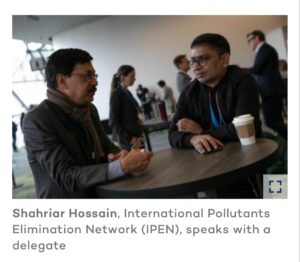
Dr. Shahriar Hossain, Technical Advisor, Environment and Social Development Organization (ESDO), as delegate
-
Siddika Sultana, Executive Director, ESDO, as observer
Day 1 message: Procedural clarity is not technical detail—it is the foundation of legitimacy and effectiveness.
Days 2–3: Operational Tensions and Strategic Decisions
The momentum continued with two packed days focused on making the Panel operational.
On Day 2, Member States met in an all-day contact group for the second reading of the draft Rules of Procedure. Progress proved deliberate and sometimes slow as debates intensified around:
-
Decision-making and voting modalities
-
The relationship between the RoP and the foundational document
-
Observer definitions and participation, including Indigenous Peoples, local communities, and groups in vulnerable situations
By Day 3, concerns about the pace prompted a pragmatic breakthrough.
Key Outcome:
The Plenary agreed to elect a partial Bureau by acclamation under UNEA Rule 18.1 for regions with uncontested nominations (two-year term).
To accelerate progress:
-
The contact group continued negotiations on observer participation, voting rules, and the foundational document.
-
A new informal group was established to address the role and operation of the Bureau and subsidiary bodies.
This marked a strategic shift—from debate toward incremental institutional establishment.
Days 4–5: Progress, Fragility, and an Adjourned Session
As the session drew to a close, urgency and institutional fragility became increasingly visible.
Despite constructive engagement and partial agreement in the RoP contact group, Members remained divided on core procedural issues particularly:
-
How to take decisions in the absence of adopted Rules of Procedure
-
Whether to provisionally apply UNEA Rules to move forward on pending deliverables
End-of-Session Status:
Progress Achieved:
-
Chair elected
-
Most Bureau members elected
-
Updated draft RoP captured as basis for future work
Pending Decisions:
-
Final adoption of Rules of Procedure
-
Trust fund arrangements
-
Secretariat location
-
Intersessional work planning
-
Dates and venue of the next session
-
Adoption of the session report
The meeting was therefore adjourned (not concluded). The Bureau was tasked with consulting Members to determine the date and venue of a resumed first session aimed at completing the foundational work and enabling the Panel to shift from procedural negotiations to delivering science-policy outputs.
Looking Ahead: From Governance to Impact
The first session of ISP-CWP demonstrated that building a credible global science-policy body requires careful institutional design. While outcomes were partial, the groundwork has been laid.
The real test now lies ahead: transforming negotiated procedures into actionable science that informs policy and protects people and the planet from harmful chemicals, waste, and pollution.
The tone is clear without trusted procedures, there can be no trusted science-policy interface.
#ISPCWP #ChemicalsAndWaste #SciencePolicyInterface #GlobalEnvironmentalGovernance #MultilateralProcess #UNEA #GenevaMeetings #ESDO #ToxicsFreeFuture