Day-1:
- At the opening handover of COP31, outgoing COP30 President André Corrêa do Lago stressed implementation via roadmaps on fossil fuels, deforestation, and USD 1.3 trillion in climate finance; COP31 President Murat Kurum urged solidarity, prioritizing vulnerable countries.
- UNFCCC’s Simon Stiell urged faster electrification and methane-emission cuts, saying progress in these two areas could reduce projected global warming by up to 0.5°C.
- UNEP discussions linked food-waste prevention, which cuts methane emissions, with financing climate-resilient food systems, connecting climate mitigation to food security and sustainable production.
Day-2:
- The Fund’s Board reported on its first extraordinary meeting responding to Nepal’s glacial collapse request; developing-country groups stressed rapid-response mechanisms, cited roughly USD 2.8 billion in requests from 119 countries, and urged developed countries to fulfil pledges.
- The G77 and China expressed disappointment over the absence of a dedicated agenda item on tripling adaptation finance and called for further discussions on baselines, monitoring, and tracking.
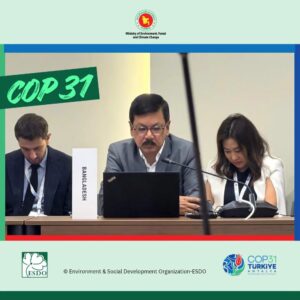
- Bangladesh, Japan and the European Union emphasized that additional guidance could help strengthen the preparation and implementation of NDCs.
Day-3:
The third day of COP31 in Antalya, Türkiye, marked the first day of the World Leaders’ Summit, with discussions focusing on clean energy transition, zero waste, circular economy and climate resilience. UN Secretary-General António Guterres called for stronger action to reduce methane emissions and improve waste management. Bangladesh also received recognition for organic waste recovery initiatives in Dhaka. These developments reinforce the importance of sustainable waste management, accessible climate finance and inclusive environmental action.
- UN Secretary-General António Guterres specifically mentioned Dhaka, alongside Durban and Kampala, as a city where organic waste is being converted into compost, fertilizer, and animal feed, helping reduce costs and create jobs.
- Khalilur Rahman, Bangladesh’s Foreign Minister and 81st UN General Assembly President, said Bangladesh’s mangroves, Amazon and Congo Basin forests, sustain the planet, yet protecting communities lack fair conservation funding; global climate action must include them.
- World leaders, including Brazil, Australia, Ethiopia, and China highlighted the importance of maintaining climate cooperation despite geopolitical tensions, armed conflicts, and economic uncertainty.
Day-4:
On day 4 of COP31, it focused on climate finance, adaptation, loss and damage, technology transfer, and just transition. Developing countries called for predictable and accessible climate finance, stronger implementation support, and recognition of their vulnerabilities. UNGA President Khalilur Rahman of Bangladesh emphasized turning climate commitments into funded programmes, strengthening early warning systems, and protecting vulnerable communities. The key message was clear: climate pledges must translate into tangible action.
- Developing-country groups insist Article 9.1 remains central to the Climate Finance Work Programme. They demanded tripled adaptation finance, easier access, grant-based and concessional funding, and NCQG implementation.
- Negotiations on the Just Transition Work Programme agree it should be extended, but parties differ on its scope and duration. Developing countries stress national flexibility, food security, access to finance and technology, and oppose unilateral trade measures.
- Bangladesh’s Khalilur Rahman, UNGA 81st Session President, told the COP31 roundtable that climate plans need funding, finance must be accessible and predictable, and success should be judged by emissions cut, resources delivered, and lives protected.
Day-5:
On the fifth day of COP31 focused on bridging the gap between climate commitments and practical implementation. Discussions highlighted the urgent need for accessible climate finance, stronger National Adaptation Plans, affordable technology transfer and grant-based support for addressing loss and damage. Developing countries, particularly the Global South, emphasized climate justice, equity and the financial responsibilities of developed nations. Bangladesh’s priorities around green industrialization, circular economy, renewable energy and climate resilience remained closely connected to these discussions.
- At Non-CO₂ Greenhouse Gases Summit, philanthropic organizations announced USD 480 million to cut methane and other super pollutants across energy, agriculture, and waste management, reflecting growing recognition of short-lived climate pollutants.
- Developing-country groups, including the African Group, LDCs, AOSIS, and China, urged grant-based, rapidly disbursed, predictable Loss and Damage Fund support, citing demand exceeding resources. The EU, Japan, Canada, New Zealand, and Norway opposed new CMA 8 guidance.
- UNDRR’s side event, “Breaking Silos, Building Resilience,” explored aligning the Rio Conventions, Sendai Framework, and 2030 Agenda, strengthening coordination across climate, biodiversity, land degradation, and disaster risk reduction. Climate resilience demands coordinated, not isolated, approaches.
Day-6:
On 14 November, the sixth day of COP31 ended the first week of technical negotiations. Talks focused on climate finance, adaptation, ocean protection, technology transfer, and just transition. Several unresolved issues were sent to the second week for more discussion. Developing countries, especially LDCs, AOSIS, and the African Group, called for accessible climate finance, stronger adaptation support, and fair technology transfer. Youth participation and women’s role in climate resilience also received attention. Delegates stressed turning climate commitments into practical support for vulnerable communities.
- The LDC Group called for accessible finance, technology transfer, and capacity-building. Developing countries struggle to implement climate commitments without enough financial and technical support.
- AOSIS and Pacific small island states want ocean priorities included in climate negotiations. They say ocean protection needs practical action, scientific evidence, and financial support for vulnerable coastal and island communities.
- S. of UNFCCC Simon Stiell stressed meaningful youth participation in climate action, saying young people bring fresh perspectives and have a stake in outcomes. UNFCCC reports 88% of 64 countries now consider youth in climate plans, up from 61%.